
Retired Machinist: They "Managed" My Back for 3 Years While the Only Part That Mattered Got Worse. Then I Found the Repair Process Nobody Bills For.
Two injections that wore off faster each time. A $14,500 surgery quote. A brother with a cane. Then a 61-year-old machinist did the math at his kitchen table — and canceled his third shot.

3,791 Ratings

May 07, 2026
My name is Dale Kowalski. I'm 61. I ran machines for 34 years, and I've got the L4/L5 to prove it.
If your injections are wearing off faster each time — 6 good weeks, then 3, then days…
If your doctor keeps saying "let's keep an eye on it" and you've stopped asking what you're keeping an eye on…
If there's a big bottle of ibuprofen in your truck door and a brace under your shirt that nobody knows about…
Then I wrote this for you. Because I was you, at my kitchen table at 2AM, doing math I didn't want to do.
The Question That Ended 3 Years of "Wait and See"
Last summer, my pain doctor pulled up my chart and said the second injection "didn't hold as long — that's not unusual" and started scheduling the third.
He was already typing when something made me ask:
"When does the disc actually heal?"
He stopped typing. Looked at me.
"Heal?"
"The herniation. When does it fix itself?"
"Mr. Kowalski, a herniated disc is a structural problem. The injections manage the inflammation. The disc itself doesn't change."
"So what changes it?"
Silence.
Then: "Surgery."
I've written up machines for 34 years. I know what it means when the only options on the work order are manage it or replace it.
It means nobody's repairing it.
What the 2AM Math Revealed
That night I couldn't sleep. Not the leg. The math.
I pulled the insurance statements out of the folder my wife keeps and laid them on the kitchen table.
First injection: $2,380. It bought 42 days of relief. That's $57 a day.
Second injection: $2,380. It bought 11 days. That's $216 a day.
The price of one day without pain had quadrupled in a single summer.
And at the bottom of the folder, the quote they'd handed me at the consult: $14,500 for surgery, after deductible. With a 1-in-4 chance, according to the research I found later, that the same disc herniates again.
Here's what made no sense: after 3 years of treatment, my leg was worse than when I started on one little pill.
Something was very wrong.
At 2:40 AM I started searching. Not "sciatica stretches" — I'd done all that. The brace. The TENS unit. The inversion table under a tarp in my garage.
I searched: "why do epidural injections wear off faster each time"
What I found made me sit straight up in my chair.
Your Disc Is the One Part That Cannot Repair Itself
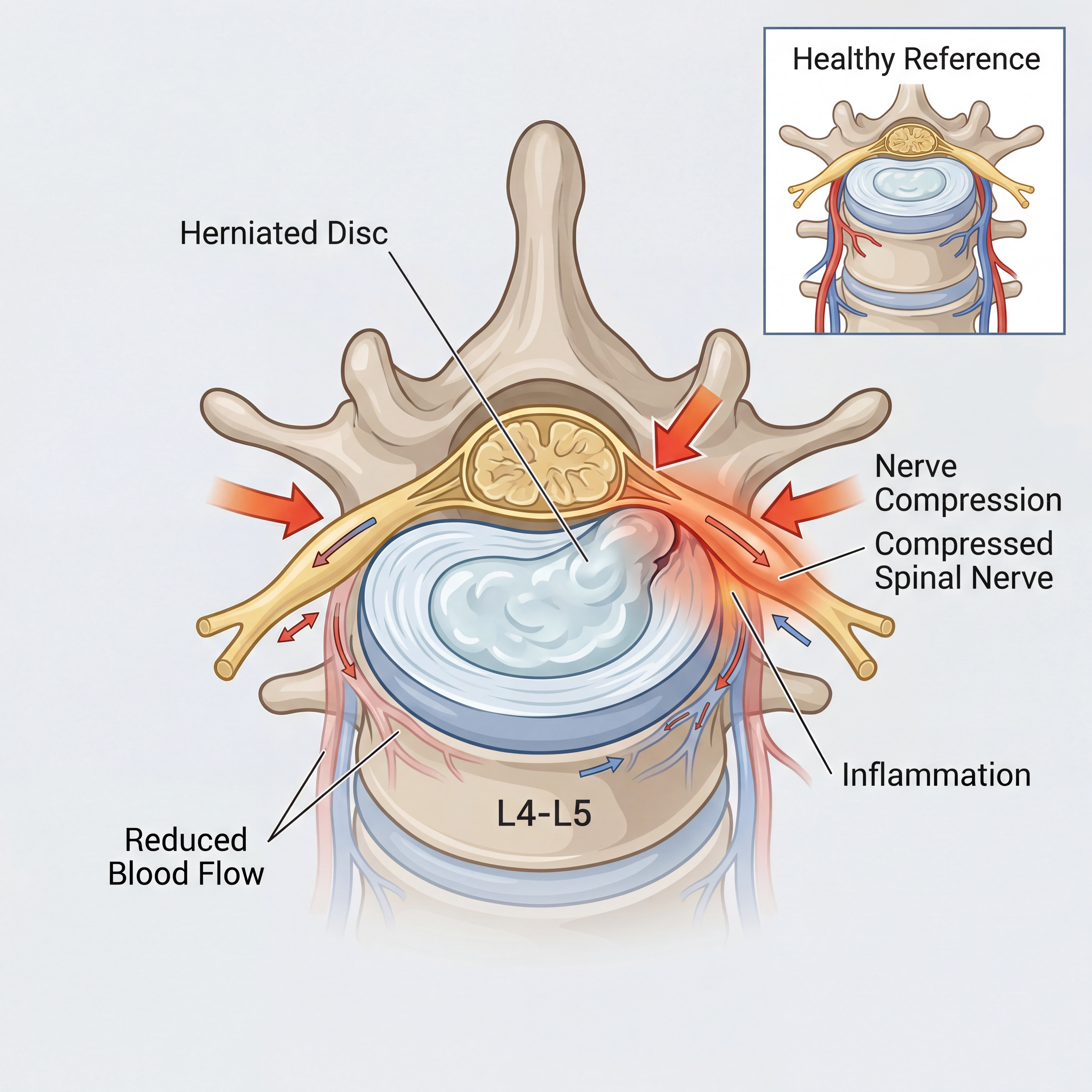
Around 3AM I found a lecture from a spine specialist. Not selling anything. Explaining.
I'm a machinist. I understand systems. And what he laid out made perfect sense in the worst possible way.
Everything in your body heals through blood flow.
Cut your hand — blood rushes in, rebuilds the tissue, done in a week. Broken bone. Torn muscle. Same machinery, every time. Blood is the repair crew.
But spinal discs sit so deep in your body that they get almost no blood supply at all.
It's the one part in the whole machine installed without a supply line.
So when a disc herniates and presses on the sciatic nerve, the repair crew that fixes everything else you've ever damaged…
…can't get to the job site.
The disc doesn't heal slowly. It doesn't heal at all.
It's a bearing running dry — year after year — while the nerve underneath it gets ground down.
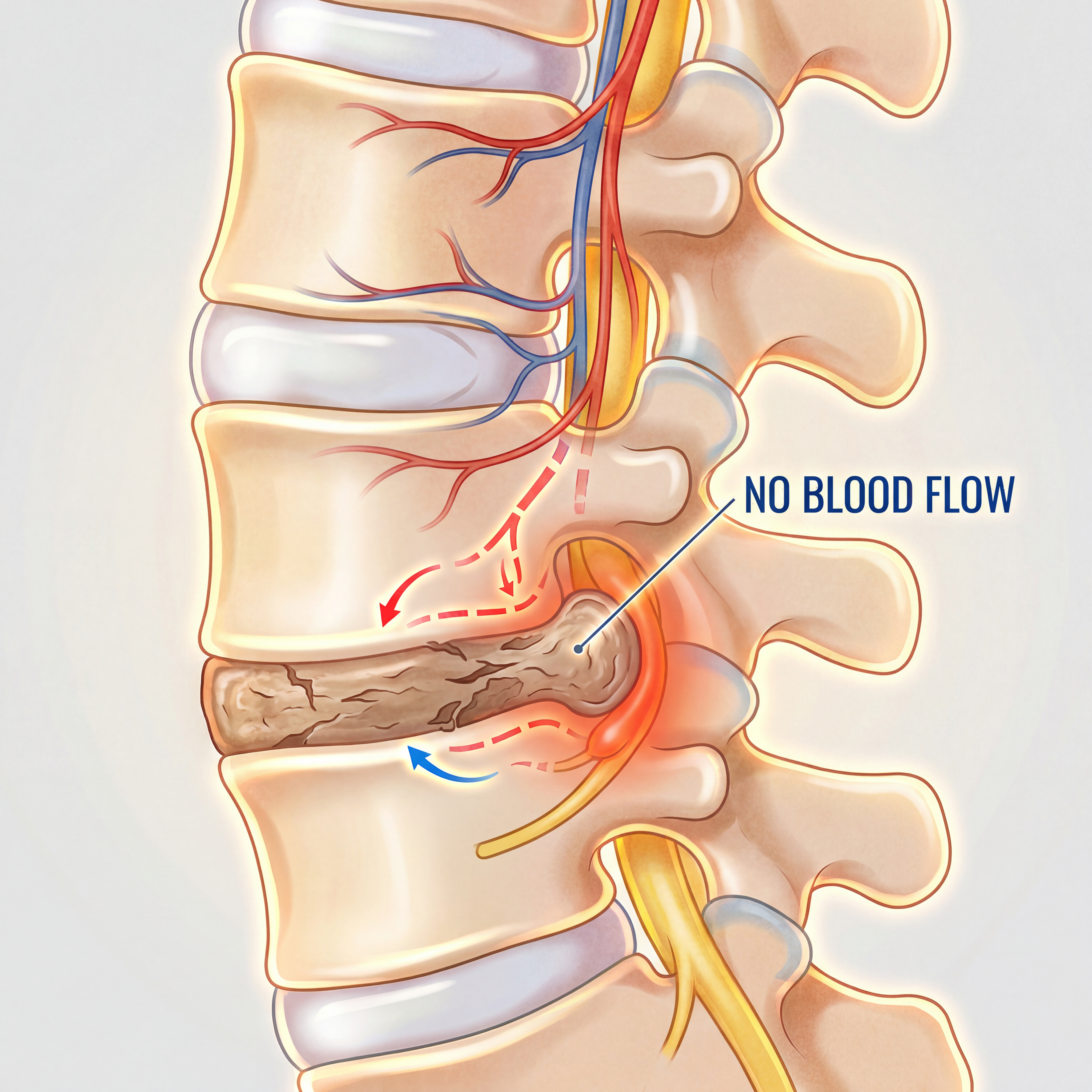
The lecture put it another way, and this one's for anybody who's kept a garden:
Picture a bed in the far corner of the yard where the sprinkler line is broken. You can reseed it every spring. Nothing grows.
Not because the soil is dead. Because the water never reaches it.
That's your disc. It was never beyond repair. It's been starving.
Why Every Treatment Wore Off — and Why Each One Bought Less

I sat there in the dark and ran my whole 3 years through that one fact.
The gabapentin? Tape over the warning light. Zero blood to the disc.
The injections? Same tape, more expensive. They switch off the swelling around the nerve for a few weeks. Zero blood to the disc.
The brace? It squeezes from outside — compression on a part that's already being crushed.
"Keep an eye on it"? That's parking a machine with a dry bearing and checking on it while it seizes.
And here's why the shots wear off faster each time.
While each treatment quiets the pain, the disc underneath keeps pressing. The part keeps wearing.
So every round of relief is covering a bigger problem than the round before.
The treatments aren't failing you. They were never aimed at the disc.
You didn't do anything wrong. Nobody ever handed you something pointed at the part.
My Brother Ran This Same Road, 5 Years Ahead of Me
My brother Danny hung drywall for 30 years. Same father's back as mine — we used to joke about "the Kowalski back" like it was a hand-me-down truck.
His L4/L5 went at 58. Mine went at 58. He was just 5 years ahead.
Same pills. Same shots that bought less each time. Same "keep an eye on it."
Year 6, his foot started catching on the stairs.
Last Thanksgiving I heard him before I saw him. Slap. Slap. Slap. His right foot hitting my porch steps — because it doesn't lift anymore.
He finally had the surgery this winter. I drove him to the follow-up. The operation went fine — pressure's off the nerve.
Danny asked one question: "So when does the foot come back?"
The surgeon looked at his chart for a long moment.
"The nerve was under pressure for a lot of years. Some of what's lost may not return. I wish I'd seen you five years ago."
I sat in that room doing a horrible piece of math.
Five years ago was Danny's year 3.
I was sitting in that room at MY year 3.
Doctors Have Watched Discs Heal on MRIs for Decades. Nobody Told Me.
Here's the part that made me angry on my brother's behalf.
It's been in medical journals for decades: herniated discs can shrink and pull back off the nerve on their own — when they get enough blood flow.
There's a medical name for it: spontaneous disc resorption.
In studies of severe herniations, doctors watched it happen in up to 96 out of 100 patients.
The disc can retreat. The nerve can recover.
While it's still capable. A nerve loses function slowly — then permanently. There's a window.
Danny's closed while everyone was keeping an eye on it. Mine was still open.
Why did nobody tell either of us? I don't think anyone's hiding it. It's simpler than that.
There's a billing code for pills. A billing code for shots. A big one for surgery.
There's no billing code for your disc healing at home. A repaired patient is a lost customer — and nobody gets paid to create those.
Getting Blood to the Disc Takes 4 Therapies. Clinics Sell Them One at a Time.
Blood can't reach a starving disc for 4 reasons. Each one already has a proven clinical fix:
Spinal decompression — takes the load off the part so it can draw fluid and blood in. You can't grease a bearing under full load. About $75 a session at a clinic.
Deep heat — pulls fresh circulation into the low back.
Red and near-infrared light — calms the swelling that blocks blood flow.
Massage — releases the muscles clamped around the disc all day like an overtightened strap.
Skip even one, and the other three can't do their job.
That's why your heating pad helps for an hour and quits. It's the only thing in your house aimed at the right problem — and it can't reach 3 inches deep or unload the part by itself.
4 therapies. 4 appointments. 4 bills. Every single week. A course of clinical decompression alone runs $2,000 to $4,000, and insurance doesn't cover a dime of it.
For a guy whose worst enemy is sitting in a car, that plan requires the exact thing his body can't do.
That was the dead end. Until a health technology company called Thrivia built all 4 into one piece of equipment.
One Belt. All 4 Therapies. 20 Minutes a Day in My Own Chair.
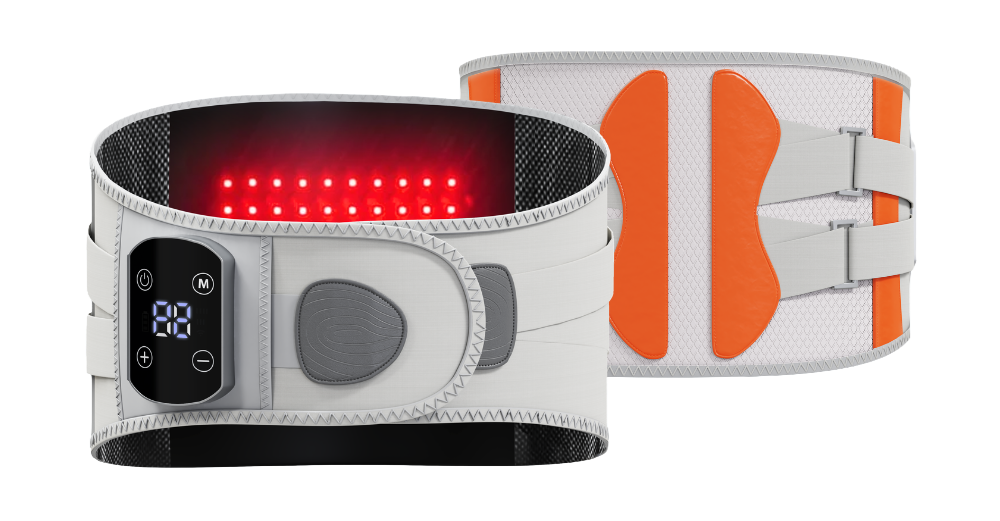
It's called the Thrivia Uni Fusion Belt.
Decompression, deep heat, red and near-infrared light, and massage — running at the same time, aimed at the same few inches of your lower spine.
You wear it 20 minutes a day. In your own chair.
I've paid $1,100 for a torque wrench. I know what the right tool costs — and I know what the wrong part costs. My brother's walking proof of the second one.
What a Session Feels Like
The moment you strap it on, the decompression system takes the pressure off your lower back.
You can feel your spine open up — like a load coming off a part that's carried it for years.
Then the heat kicks in, driving fresh blood to the disc and delivering the oxygen and nutrients it's been starved of.
The red and near-infrared light gets to work on the swelling that's been blocking the way.
And the massage releases the tight muscles on both sides of your spine.
All 4 therapies. At the same time. Giving the disc what it's been missing.
And because I know the questions a man asks before he buys a tool — I asked them all:
- You put it on yourself, standing in your kitchen — no second pair of hands needed
- Controls sit on the front, where you can actually see them
- Nothing to re-stick, no pads to rebuy, no batteries to hunt — it recharges like a phone
- Adjustable fit for waists roughly 26" to 55" — measure at the hips with a soft tape
- One button. If you can run a microwave, you can run this.
Now — the question every smart man asks:
"If this works, why didn't my doctor mention it?"
Ask your doctor about decompression, heat, light, and massage. Most will tell you all 4 are legitimate, proven therapies.
What nobody's been able to hand you is all 4 at once, at home. That's the only new part.
And here's the honest part — because you've been burned before, and so have I. There's a drawer in my house too.
Discs heal in weeks, not days. Anyone promising overnight relief is selling you something.
So don't take my word for anything. Do what a machinist does: pick one gauge and watch it.
Track how long you can sit before the leg lights up. Write it down on day 1 — pencil on the workbench works fine. Check it every week.
Here's my pad, word for word:
Baseline: 15 minutes in a kitchen chair. Week 2: 20 minutes. Week 4: stood at the stove through a whole pot of chili. Week 6: 40 minutes — Sunday dinner, start to finish. Week 8: called the pain clinic and canceled the third injection. Week 10: drove 2 hours to Danny's and back, same day.
Month 5, a follow-up MRI: the herniation had visibly pulled back off the nerve. Still there — retreating.
My doctor read the report twice and asked what I'd been doing. I told him — the starving disc, the 4 therapies, the belt.
"I'm not familiar with this."
"I know," I said. "That's exactly the problem."
What Other People Like Me Report

Ronald T.

I'm a believer now and will never go without it
Verified Purchase
32 years pouring concrete. Two shots that quit on me, doctor talking surgery. Tracked my sitting like the article says — 12 minutes when I started, 45 by week 4. Back out at the woodpile this fall, taking it slow but it's my woodpile. I'm a skeptic by nature. My wife will confirm.
16 people found this helpful

Sandra K.
So glad I got this for my husband
Verified Purchase
He would never have ordered it himself — you know how they are. Wore it "to humor me" the first week. He now reminds ME it's his 20 minutes. First Sunday dinner he sat all the way through in two years, I went in the kitchen and cried. Ordering was easy and it fit him fine (he's a big guy).
14 people found this helpful
Gerald M.
Wish I'd found it at year 3 instead of year 12
Verified Purchase
12 years. Stenosis and arthritis on top of the herniation, drawer full of gadgets. This didn't undo the damage that's done — nothing will, and don't believe anyone who says different. But the burning down my leg is a whisper of what it was and I walk my block again. "Worth a try" was my exact thinking. It was worth more than that.
14 people found this helpful
This Belt Has Already Helped Thousands of People
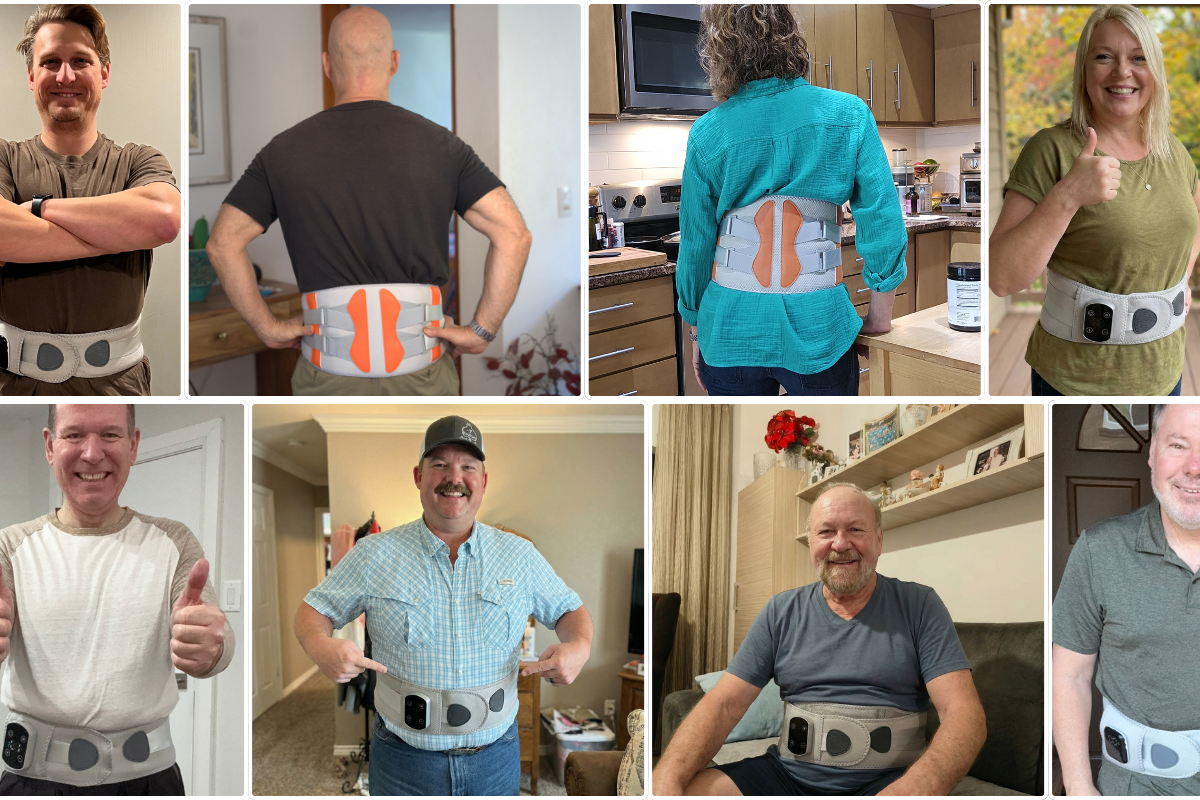
And based on what happened at my house, I believe it can help at yours.
Just imagine…
- No more picking your chair at family dinner by which one is easiest to get out of
- No more lying awake at 2am trying to find a position that doesn't hurt
- No more handing your Saturdays — the woodpile, the garage, the yard — to somebody younger
- No more feeling like the work you did for 30 years gets to collect forever
That's what happens when the part finally gets what it needs.
You don't just get relief. You get yourself back.
First — Who Should NOT Buy This
If you've lost bladder or bowel control, or your foot visibly drags or slaps when you walk — stop reading.
That's past any belt. You need a surgeon, this week. My brother walked that road slow. You run it.
And if your shots hold you a year, or your dose has worked for 20 — keep doing what works. This isn't for you.
This is for the ones whose relief keeps coming back smaller. For everyone in that boat, here's the math.
What It Actually Costs
Getting these 4 therapies at clinics costs thousands of dollars over months. A single course of spinal decompression alone runs $2,000 to $4,000 — and my one injection was $2,380 for 11 days.
Given what's inside this device, it could easily sell for $600 to $700.
Thrivia priced it at $199.99.
Use it once a day for a year, and that comes out to less than 55 cents per session.
55 cents for all 4 therapies. Working together. From your own chair.
But that's not even what you'll pay today.
NOTE: The Thrivia Uni Fusion Belt is not sold on Amazon, eBay, Walmart or in stores. Anything similar you find there is a knockoff. The only place to get the real one is the official website below.
Get 55% OFF the Thrivia Uni Fusion Belt Today

Through this page, the belt is 55% off: just $89.99. With free US shipping.
Less than one injection co-pay. Less than a good pair of work boots. A tenth of a torque wrench.
It also comes with the Disc Recovery Protocol — a printed week-by-week guide. What to do, what to track, what week 2 and week 4 should feel like.
A timeline. The thing nobody in an exam room will give you anymore.
GET 55% OFF Thrivia Uni Fusion Belt Now!You Have 60 Days to Try It, Completely Risk-Free
Not 30 days. 60.
Because disc healing takes weeks — and you deserve enough time to check the numbers in your own handwriting.
My rule for 34 years: any tool that can't do the job goes back to the store. Same rule here.
Wear it 20 minutes a day. Track how long you can sit, stand, or drive before the leg lights up.
If your number isn't clearly moving inside 3 weeks, send it back and get every dollar.
It doesn't matter if it's 59 minutes or 59 days after your purchase. If you're not happy, you don't pay. It's on us.
That's a guarantee no surgeon will ever give you. Ask my brother — his didn't come with one.
TRY IT RISK-FREE FOR 60 DAYS — $89.99Two Ways This Goes

You can stay on the conveyor belt — the refills, the shots that buy less each time at $2,380 apiece, the "keep an eye on it" while the part runs dry.
Left alone, the disc keeps pressing on the nerve. Day after day. The numbness spreads. The leg gets weaker.
Some people end up needing the $14,500 surgery they spent years avoiding — after the years have already taxed the nerve.
I don't have to imagine how that road ends. I eat Thanksgiving dinner with it. I listen for it on my porch steps.
Or you can spend 60 days finding out what a starving disc does when it finally gets fed.
Measured weekly. In your own handwriting. At zero risk.
The shots and the waiting room will still be there.
The question is whether you'll still need them.
Here's What To Do Next
Click the button below — it takes you straight to the official Thrivia website.
Select your package, enter your shipping info, and you're done. Most people order in a few minutes.


60 Day Money Back Guarantee

Fast & FREE Shipping

Safe & Secure Checkout

Easy Returns
Comments
Tyler Levon
Electrician, 38 years in. Same story as this guy almost exactly, shots quit on me too. Week 2 with the belt, keeping the pencil log like the article says. Sitting number went from 12 minutes to 25. Not calling it a miracle yet but the number don't lie.
Sarah Lopez
Keep the log going Tyler. My dad did the same thing, week 5 is when he stopped talking about it and just started using it every morning with his coffee.
Bridget Prescott
For anyone wondering about sizing like I was — I ordered for my husband who is a big guy and it adjusted fine, it fits waists from about 26 to 55 inches. He can put it on himself standing up which was the whole point.
Emma Emerson
Honest question. I'm 22 years into this — stenosis and arthritis on top of the herniation, done the shots, own a TENS unit and two braces that did nothing. Is it too late for someone like me or is this just for the newer cases?
Jack Smith
Emma I'm 14 years in with a similar list so I'll give it to you straight. It didn't touch my arthritis, that part's mine to keep. But the nerve burning down my leg — the article's right, that part was still alive, and that's the part that changed. Week 3 for me. The braces squeeze, this stretches. Different animal.
Leonard Boyd
My wife ordered this after watching me grip the counter for a year. I wore it to humor her. I owe her an apology and she knows it. Standing at my workbench again most mornings.
Debra Peyton
Should have bought it earlier. The walk to my mailbox was my whole measure of how bad things were. Now I do the block. If you know, you know.